Rebuilding a Global Flagship Brand System Under Pressure
Rebuilding a Global Flagship Brand System Under Pressure
Global brand governance, localization-first design, and decentralized scale across 26 markets
Global brand governance, localization-first design, and decentralized scale across 26 markets
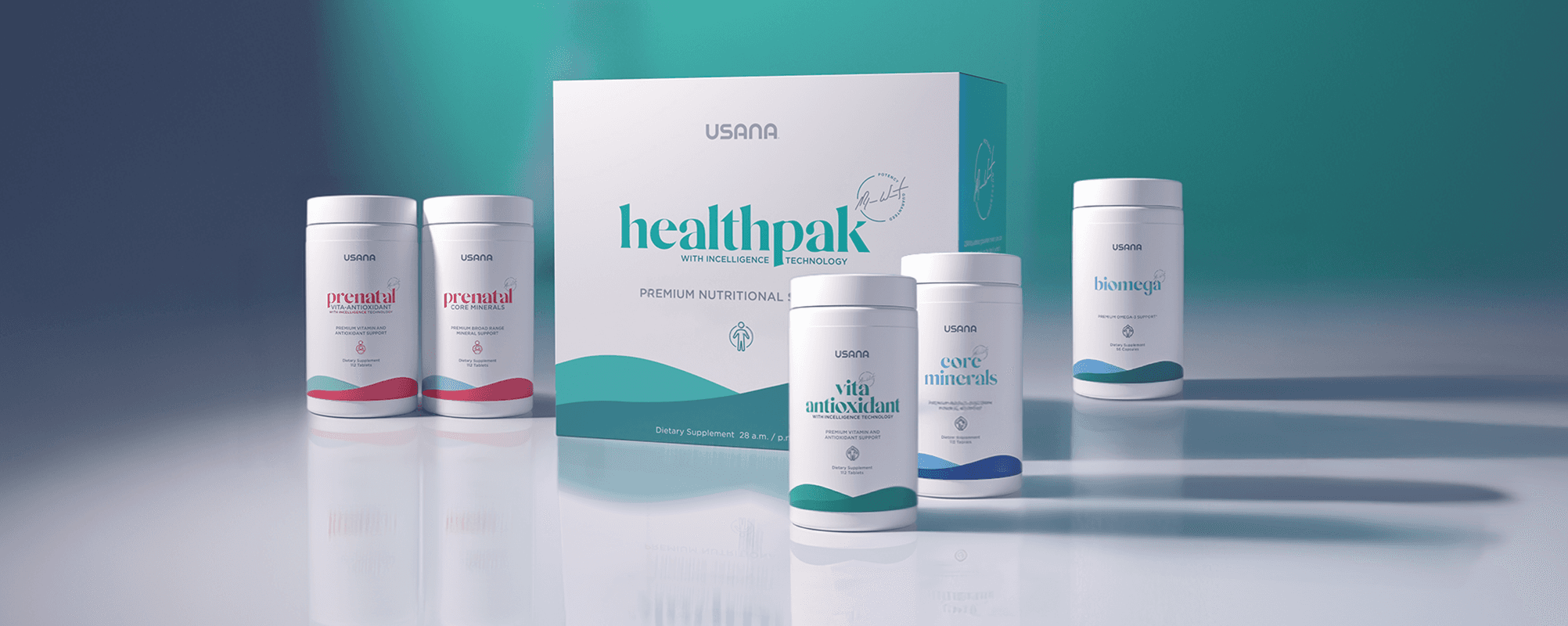
Summary: When a rushed flagship product launch exposed systemic brand and localization failures across 26 markets, I rebuilt the underlying design system mid-flight—restoring trust, enabling decentralization, and creating a foundation flexible enough to support complex launches, including India.
Summary: When a rushed flagship product launch exposed systemic brand and localization failures across 26 markets, I rebuilt the underlying design system mid-flight—restoring trust, enabling decentralization, and creating a foundation flexible enough to support complex launches, including India.
My Role: Director, Global Creative Services
Scope: Global flagship product line, 26 markets
Focus: Brand governance, localization, system design
My Role: Director, Global Creative Services
Scope: Global flagship product line, 26 markets
Focus: Brand governance, localization, system design
Systems hold under pressure—creativity does not.
Context & Stakes
Context & Stakes
When I stepped into leadership of Global Creative Services, the company’s flagship product refresh was already in motion — partially live in some markets, delayed or stalled in others.
The launch had been rushed under prior ownership, and the cracks were showing everywhere.
Global markets were frustrated by long delays and assets that felt poorly adapted to their regions. What should have been a unifying brand moment instead reinforced a sense of hierarchy — headquarters first, markets second. In some regions, localization issues went beyond awkwardness and into territory that felt dismissive or culturally inattentive.
At headquarters, project managers were overwhelmed by the volume of revisions required to make the system function. Designs were slow to adapt to regional requirements, and workflows buckled under the strain of constant rework. Confidence in the process — and in the creative organization itself — was eroding.
Externally, customers were noticing. Typos, inconsistencies, and mismatched executions surfaced publicly, undermining trust in the brand at the exact moment the flagship product was meant to reaffirm it.
Internally, leadership had lost faith that the existing creative system could deliver at the level required — at scale, across markets, and under commercial pressure.
The challenge was no longer cosmetic. It was systemic.
A flagship product is not just a collection of assets; it is a declaration of how a brand sees itself and how it respects its audiences. When the system supporting that declaration fails, the damage compounds quickly — across teams, markets, and trust.
I stepped into the role with a clear understanding of what was at stake:
this was not a matter of fixing files, but of rebuilding a brand system mid-flight — while restoring credibility with global markets, internal partners, and leadership simultaneously.
When I stepped into leadership of Global Creative Services, the company’s flagship product refresh was already in motion — partially live in some markets, delayed or stalled in others.
The launch had been rushed under prior ownership, and the cracks were showing everywhere.
Global markets were frustrated by long delays and assets that felt poorly adapted to their regions. What should have been a unifying brand moment instead reinforced a sense of hierarchy — headquarters first, markets second. In some regions, localization issues went beyond awkwardness and into territory that felt dismissive or culturally inattentive.
At headquarters, project managers were overwhelmed by the volume of revisions required to make the system function. Designs were slow to adapt to regional requirements, and workflows buckled under the strain of constant rework. Confidence in the process — and in the creative organization itself — was eroding.
Externally, customers were noticing. Typos, inconsistencies, and mismatched executions surfaced publicly, undermining trust in the brand at the exact moment the flagship product was meant to reaffirm it.
Internally, leadership had lost faith that the existing creative system could deliver at the level required — at scale, across markets, and under commercial pressure.
The challenge was no longer cosmetic. It was systemic.
A flagship product is not just a collection of assets; it is a declaration of how a brand sees itself and how it respects its audiences. When the system supporting that declaration fails, the damage compounds quickly — across teams, markets, and trust.
I stepped into the role with a clear understanding of what was at stake:
this was not a matter of fixing files, but of rebuilding a brand system mid-flight — while restoring credibility with global markets, internal partners, and leadership simultaneously.
The launch had been rushed under prior ownership, and the cracks were showing everywere.
The Tension
The Tension
On the surface, leadership’s ask was straightforward: restore stability and regain momentum.
The launch needed to move forward. Complaints needed to quiet down. Confidence — internally and externally — needed to be rebuilt quickly.
But beneath that request was a more complex reality.
The instability wasn’t coming from missed deadlines alone. It was coming from a design system that had been built without sufficient rigor, cultural awareness, or structural flexibility — and from an internal creative culture that had normalized rushing decisions without accountability for downstream impact.
Global markets felt ignored.
Project managers were stuck compensating for a system that couldn’t adapt.
Designers were reacting instead of leading.
Leadership was responding to symptoms without visibility into the root cause.
Speed without intervention would only harden the damage.
Stability without reform would have been cosmetic.
The real tension was this:
Leadership needed immediate confidence that the launch could be salvaged
Global markets needed proof they were respected, not retrofitted
The creative organization needed clarity, ownership, and a reset of expectations
All of it had to happen mid-launch, without stopping the business
This wasn’t a problem that could be solved with better execution alone.
It required acknowledging that the system itself — and the behaviors it enabled — were no longer fit for scale.
The work ahead would need to deliver visible progress quickly, while quietly rebuilding the foundations underneath: governance, trust, and shared standards that could hold across cultures, timelines, and commercial pressure.
That meant resisting the urge to move faster in the short term, in order to move more reliably — and more respectfully — in the long term.
On the surface, leadership’s ask was straightforward: restore stability and regain momentum.
The launch needed to move forward. Complaints needed to quiet down. Confidence — internally and externally — needed to be rebuilt quickly.
But beneath that request was a more complex reality.
The instability wasn’t coming from missed deadlines alone. It was coming from a design system that had been built without sufficient rigor, cultural awareness, or structural flexibility — and from an internal creative culture that had normalized rushing decisions without accountability for downstream impact.
Global markets felt ignored.
Project managers were stuck compensating for a system that couldn’t adapt.
Designers were reacting instead of leading.
Leadership was responding to symptoms without visibility into the root cause.
Speed without intervention would only harden the damage.
Stability without reform would have been cosmetic.
The real tension was this:
Leadership needed immediate confidence that the launch could be salvaged
Global markets needed proof they were respected, not retrofitted
The creative organization needed clarity, ownership, and a reset of expectations
All of it had to happen mid-launch, without stopping the business
This wasn’t a problem that could be solved with better execution alone.
It required acknowledging that the system itself — and the behaviors it enabled — were no longer fit for scale.
The work ahead would need to deliver visible progress quickly, while quietly rebuilding the foundations underneath: governance, trust, and shared standards that could hold across cultures, timelines, and commercial pressure.
That meant resisting the urge to move faster in the short term, in order to move more reliably — and more respectfully — in the long term.
Speed without intervention would only harden the damage.
Stability without reform would have been cosmetic.
Reframing The Problem
Reframing The Problem
Influence without theatrics
Influence without theatrics
There was no formal moment where permission was granted to pause the launch and rebuild the underlying system.
There couldn’t have been.
The business was already in motion, and leadership needed visible progress. What they lacked — and what the organization needed — was a shared understanding of why progress kept breaking down, and what kind of intervention would actually stabilize it.
Rather than attempting a top-down reset, I focused on rebuilding alignment where it mattered most, in parallel.
With Marketing leadership, I worked to re-establish a clear, shared articulation of what the flagship brand was — and what it needed to be — beyond the immediate pressures of launch. This created a north star that could guide decisions consistently, instead of reacting market by market or asset by asset.
With global markets, I shifted the dynamic from notification to collaboration. Many teams had been informed of changes after decisions were already made, leaving them to adapt work that never fully accounted for their realities. I prioritized listening first — understanding where the system failed them — and then gradually reintroducing clarity around a vision they could see themselves reflected in. Ownership followed respect.
With Project Management, I was direct. The existing workflows were designed for a level of stability the creative system could not yet support. Rather than masking that gap, I was explicit about current constraints, likely failure points, and where rebuilding efforts were headed. This allowed their teams to adjust expectations, timelines, and processes in ways that reduced friction instead of amplifying it.
These conversations didn’t happen in a single meeting, and they weren’t framed as a formal overhaul. They happened through consistent decision-making, shared language, and visible follow-through.
As clarity increased across functions, the system began to stabilize — not because pressure was removed, but because it was finally being distributed realistically.
By the time outcomes improved at the executive level, the work of reframing had already done its job. The focus shifted from managing exceptions to trusting the direction of the system.
There was no formal moment where permission was granted to pause the launch and rebuild the underlying system.
There couldn’t have been.
The business was already in motion, and leadership needed visible progress. What they lacked — and what the organization needed — was a shared understanding of why progress kept breaking down, and what kind of intervention would actually stabilize it.
Rather than attempting a top-down reset, I focused on rebuilding alignment where it mattered most, in parallel.
With Marketing leadership, I worked to re-establish a clear, shared articulation of what the flagship brand was — and what it needed to be — beyond the immediate pressures of launch. This created a north star that could guide decisions consistently, instead of reacting market by market or asset by asset.
With global markets, I shifted the dynamic from notification to collaboration. Many teams had been informed of changes after decisions were already made, leaving them to adapt work that never fully accounted for their realities. I prioritized listening first — understanding where the system failed them — and then gradually reintroducing clarity around a vision they could see themselves reflected in. Ownership followed respect.
With Project Management, I was direct. The existing workflows were designed for a level of stability the creative system could not yet support. Rather than masking that gap, I was explicit about current constraints, likely failure points, and where rebuilding efforts were headed. This allowed their teams to adjust expectations, timelines, and processes in ways that reduced friction instead of amplifying it.
These conversations didn’t happen in a single meeting, and they weren’t framed as a formal overhaul. They happened through consistent decision-making, shared language, and visible follow-through.
As clarity increased across functions, the system began to stabilize — not because pressure was removed, but because it was finally being distributed realistically.
By the time outcomes improved at the executive level, the work of reframing had already done its job. The focus shifted from managing exceptions to trusting the direction of the system.
There was no formal moment where permission was granted to pause the launch and rebuild the underlying system…
The Decision Space
The Decision Space
I set a small number of non-negotiables that governed every decision moving forward.
I set a small number of non-negotiables that governed every decision moving forward.
Once it was clear that the instability stemmed from the system itself — not just its execution — I set a small number of non-negotiables that would govern every decision moving forward.
The most critical was this:
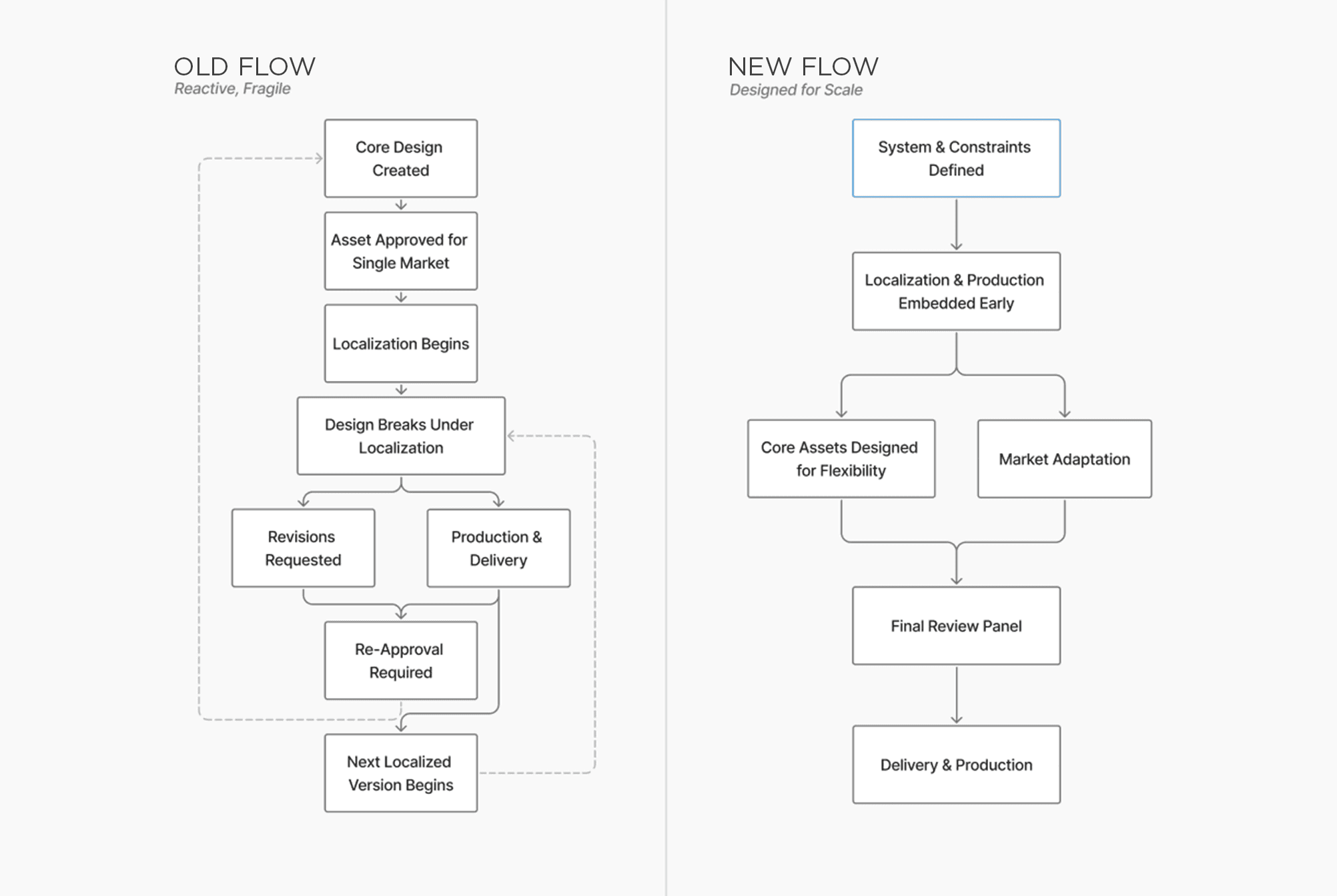
Localization could no longer be treated as a downstream task.
It had to be designed for from the very first deliverable.
The organization had been localizing products for decades. The fact that localization requirements were not structurally accounted for in initial design phases wasn’t just inefficient — it was professionally embarrassing. It signaled a breakdown in how knowledge, authority, and respect were distributed across the creative ecosystem.
From that principle flowed several immediate decisions.
No asset would ship without a system behind it. That meant stepping back from individual executions and rebuilding the scaffolding underneath them — templates, rules, constraints, and flex points that could support regional adaptation without constant reinvention.
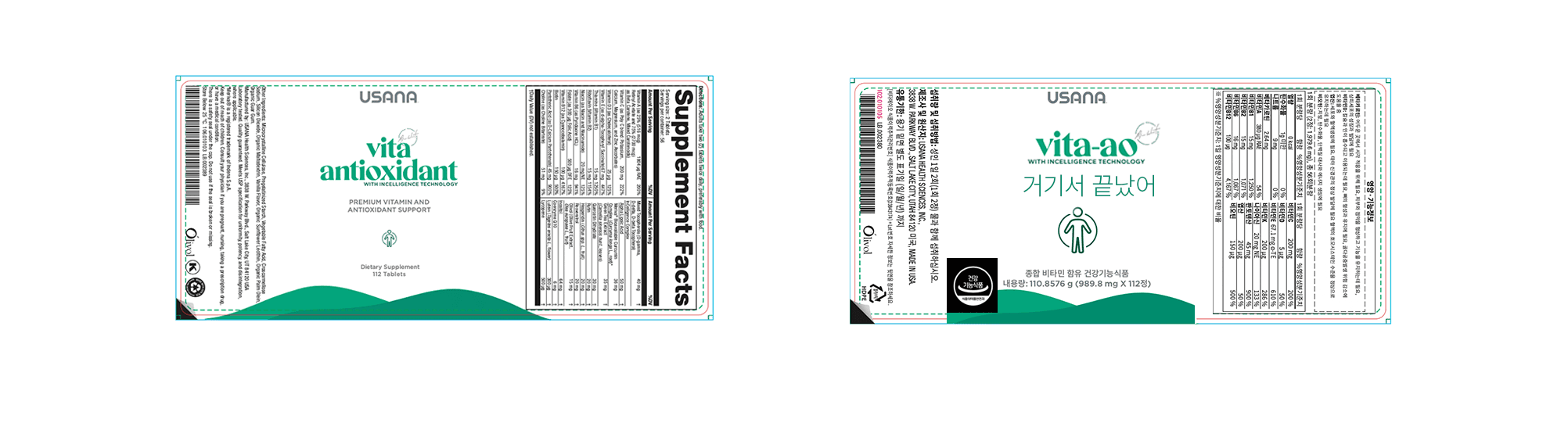
To do this properly, the localization and production design teams had to be repositioned within the process. Historically, they had been brought in after creative decisions were made — informed rather than consulted — despite holding critical knowledge about what would and would not work across markets. This dynamic not only degraded quality; it eroded morale and accountability.
We stopped that immediately.
Production design and localization partners were brought into the earliest stages of concept and system design. Their expertise was treated as essential, not corrective. Authority over the integrity of localized assets was explicitly shared, giving those teams both ownership and responsibility for quality outcomes.
This shift required recalibrating internal hierarchies. Senior designers were asked to see system design and localization not as a reduction of creative purity, but as an expansion of creative responsibility. Creativity that cannot survive scale is not finished work.
By elevating production design from a subordinate function to a respected partner, the system began to change in meaningful ways: fewer revisions, clearer constraints, faster adaptation, and — most importantly — restored pride in the work across markets.
The decision to rebuild this way was not the fastest path in the short term. But it was the only path that could produce speed, consistency, and dignity at scale.
Once it was clear that the instability stemmed from the system itself — not just its execution — I set a small number of non-negotiables that would govern every decision moving forward.
The most critical was this:
Localization could no longer be treated as a downstream task.
It had to be designed for from the very first deliverable.
The organization had been localizing products for decades. The fact that localization requirements were not structurally accounted for in initial design phases wasn’t just inefficient — it was professionally embarrassing. It signaled a breakdown in how knowledge, authority, and respect were distributed across the creative ecosystem.
From that principle flowed several immediate decisions.
No asset would ship without a system behind it. That meant stepping back from individual executions and rebuilding the scaffolding underneath them — templates, rules, constraints, and flex points that could support regional adaptation without constant reinvention.
To do this properly, the localization and production design teams had to be repositioned within the process. Historically, they had been brought in after creative decisions were made — informed rather than consulted — despite holding critical knowledge about what would and would not work across markets. This dynamic not only degraded quality; it eroded morale and accountability.
We stopped that immediately.
Production design and localization partners were brought into the earliest stages of concept and system design. Their expertise was treated as essential, not corrective. Authority over the integrity of localized assets was explicitly shared, giving those teams both ownership and responsibility for quality outcomes.
This shift required recalibrating internal hierarchies. Senior designers were asked to see system design and localization not as a reduction of creative purity, but as an expansion of creative responsibility. Creativity that cannot survive scale is not finished work.
By elevating production design from a subordinate function to a respected partner, the system began to change in meaningful ways: fewer revisions, clearer constraints, faster adaptation, and — most importantly — restored pride in the work across markets.
The decision to rebuild this way was not the fastest path in the short term. But it was the only path that could produce speed, consistency, and dignity at scale.
Localization could no longer be treated as a downstream task.
Creativity that cannot survive scale is not finished work.
Outcomes
Outcomes
What changed once the system changed
What changed once the system changed
The most meaningful outcome of rebuilding the system wasn’t speed or efficiency — though both improved significantly.
It was trust.
As localization and production teams were brought into the process as respected partners, something shifted across markets. Teams that had previously gone quiet — voicing concerns privately, if at all — began speaking up earlier and more constructively about what wasn’t working. The dynamic moved from complaint to collaboration.
Markets expressed pride in the work again. Not because everything was suddenly perfect, but because they could see themselves reflected in the process and the product. Their expertise was no longer an afterthought; it was built into the system from the start.
Operationally, the impact was immediate and measurable. Revisions on product deliveries dropped significantly as constraints became clearer and decisions more durable. Cross-functional final review panels were established, dramatically reducing preventable errors such as typos, misalignments, and inconsistent executions before assets reached production.
As internal systems stabilized, the organization was able to move out of reactive troubleshooting and into more strategic partnerships. We shifted focus toward identifying vendors and production partners who could reliably execute at the level the brand required — aligned with a shared internal vision, rather than compensating for its absence.
This stability gave leadership confidence that more complex initiatives were now feasible. The eventual launch of India — with requirements that diverged meaningfully from other markets — became possible not through exception-making, but because the system was finally flexible enough to support it.
Perhaps the most telling signal came from within the creative organization itself. The new production and localization structure was informally named “The L-Panel” by the team — a shorthand for a process they trusted and a standard they were proud to uphold.
For me, that moment mattered more than any metric. It meant the people closest to the work felt seen, respected, and confident that quality was no longer something they had to fight for alone.
The most meaningful outcome of rebuilding the system wasn’t speed or efficiency — though both improved significantly.
It was trust.
As localization and production teams were brought into the process as respected partners, something shifted across markets. Teams that had previously gone quiet — voicing concerns privately, if at all — began speaking up earlier and more constructively about what wasn’t working. The dynamic moved from complaint to collaboration.
Markets expressed pride in the work again. Not because everything was suddenly perfect, but because they could see themselves reflected in the process and the product. Their expertise was no longer an afterthought; it was built into the system from the start.
Operationally, the impact was immediate and measurable. Revisions on product deliveries dropped significantly as constraints became clearer and decisions more durable. Cross-functional final review panels were established, dramatically reducing preventable errors such as typos, misalignments, and inconsistent executions before assets reached production.
As internal systems stabilized, the organization was able to move out of reactive troubleshooting and into more strategic partnerships. We shifted focus toward identifying vendors and production partners who could reliably execute at the level the brand required — aligned with a shared internal vision, rather than compensating for its absence.
This stability gave leadership confidence that more complex initiatives were now feasible. The eventual launch of India — with requirements that diverged meaningfully from other markets — became possible not through exception-making, but because the system was finally flexible enough to support it.
Perhaps the most telling signal came from within the creative organization itself. The new production and localization structure was informally named “The L-Panel” by the team — a shorthand for a process they trusted and a standard they were proud to uphold.
For me, that moment mattered more than any metric. It meant the people closest to the work felt seen, respected, and confident that quality was no longer something they had to fight for alone.
The new production and localization structure became known internally as “The L-Panel” — a shared standard teams trusted and protected.
Reflection
Reflection
Before this experience, I had internalized a familiar model of creative leadership: the creative director as bottleneck — the person who sees everything, checks everything, and carries personal responsibility for every detail. Long hours, constant intervention, and heroic oversight were often framed as signs of commitment and excellence.
This work fundamentally changed that belief.
What I saw, once the system was rebuilt, was that capability already existed throughout the organization. There were people who were not only able to own quality, judgment, and detail — they were eager to do so. What they lacked wasn’t talent or care; it was permission, clarity, and trust.
By designing a system that distributed authority instead of concentrating it, my role shifted. I moved from managing outcomes personally to influencing how outcomes were shaped — through principles, constraints, shared language, and respect for expertise at every level.
That shift expanded my impact. It allowed the organization to scale quality without scaling control, and it allowed me to lead more strategically without being embedded in every decision.
I no longer believe that great creative leaders are defined by how much they personally touch. I believe they are defined by how well they design environments where good decisions can be made — consistently, collaboratively, and with pride.
That philosophy continues to guide how I approach brand leadership today: influence over micromanagement, systems over heroics, and respect as the foundation for scale.
Before this experience, I had internalized a familiar model of creative leadership: the creative director as bottleneck — the person who sees everything, checks everything, and carries personal responsibility for every detail. Long hours, constant intervention, and heroic oversight were often framed as signs of commitment and excellence.
This work fundamentally changed that belief.
What I saw, once the system was rebuilt, was that capability already existed throughout the organization. There were people who were not only able to own quality, judgment, and detail — they were eager to do so. What they lacked wasn’t talent or care; it was permission, clarity, and trust.
By designing a system that distributed authority instead of concentrating it, my role shifted. I moved from managing outcomes personally to influencing how outcomes were shaped — through principles, constraints, shared language, and respect for expertise at every level.
That shift expanded my impact. It allowed the organization to scale quality without scaling control, and it allowed me to lead more strategically without being embedded in every decision.
I no longer believe that great creative leaders are defined by how much they personally touch. I believe they are defined by how well they design environments where good decisions can be made — consistently, collaboratively, and with pride.
That philosophy continues to guide how I approach brand leadership today: influence over micromanagement, systems over heroics, and respect as the foundation for scale.
Influence over micromanagement.
Systems over heroics.
Respect as the foundation for scale.